 Constructionshows
SAMOTER 2026 UNDER STARTER’S ORDERS – THE STRENGTH OF THE CONSTRUCTION SECTOR ON SHOW AT VERONAFIERE
526 EXHIBITORS AND TOP BUYERS INVITED FROM 23 COUNTRIES
FOCUS ON THE CONSTRUCTION SITE OF THE FUTURE
The 32nd triennial International Construction Equipment Exhibition was presented in Rome yesterday. All the top names in the sector will attend the trade fair.
CER-Unacea Research: The Italian construction machinery sector is worth 4 billion euros and boast 85,000 employees. Strong international vocation: 70% of production is exported. 26,000 units were sold in Italy in 2025, double the number compared to 2017. Italy is Europe’s third-largest market, having overtaken France and has grown by 38.8% since 2019, going against the 9.4% average decline trend in Europe
Rome, 28 April 2026 – The 32nd edition of SaMoTer. Scheduled 6-9 May 2026, the triennial International Construction Machinery Exhibition is under the spotlights again at the Verona Exhibition Centre with 526 exhibitors (124 international from 22 countries), bringing together the leading brands and their global excellence in construction site mechanization. In all, 6 show halls and 3 outdoor areas will welcome visitors to the exhibition alongside demo areas for dynamic tests for an overall total of 52,000 square metres.
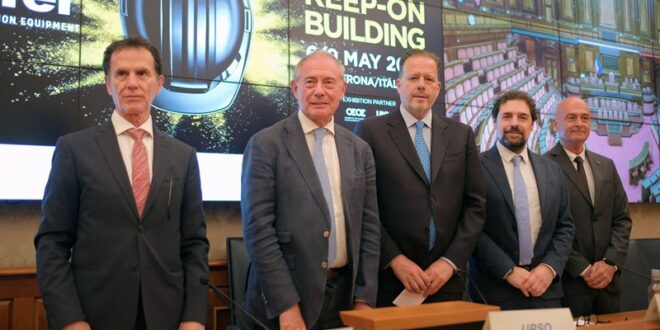
The trade fair, organized by Veronafiere in partnership with Unacea (Italian Construction Machinery Union) and Cece (European Construction Equipment Federation), was presented yesterday morning in Rome, in the Nassirya Hall of Palazzo Madama – the Senate of the Republic of Italy.
The presentation was attended by Adolfo Urso, Minister of Enterprise and Made in Italy, Federico Bricolo, President of Veronafiere, Maurizio Forte, Central Director of ITA-Italian Trade Agency (in video-connection), Luca Nutarelli, Director of Unacea, Stefano Fantacone, Research Director of CER (Centro Ricerche Europeo) and Matteo Pasinato, SaMoTer event manager (their comments are given at the end of this press release). Other attendees also included the undersecretary of MIMIT, Mara Bizzotto, and Senator Matteo Gelmetti. The event was moderated by journalist Giuseppe De Filippi.
SaMoTer is the only exhibition in Italy specifically for the construction equipment supply chain: from earthmoving to hoisting/lifting, demolition and drilling, not to mention crushing and quarry/construction site vehicles, as well as concrete, the road-building sector, without overlooking equipment, engine components, spare parts, logistics, services and ICT solutions. The Italian construction equipment sector plays a strategic role in the national mechanical engineering industry and is a key enabler for the development of infrastructures and the sustainable transition of the construction industry.
SaMoTer confirms its status as a b2b platform of international calibre: this year, more than 60 top international buyers have been invited from 23 countries in Central and Eastern Europe, Scandinavia, the CIS region, Eurasia, the Middle East, North Africa, and sub-Saharan Africa. In addition, there a further 40 operators were selected from target markets thanks to the collaboration with ITA-Italian Trade Agency, not to mention all the other high-profile professionals arriving from abroad.
The construction machinery sector enjoys a vocation for exports and this event is a preferential venue for consolidating business relationships, presenting innovations, and identifying new business opportunities in emerging and established markets through a series of targeted meetings.
Research conducted by CER (Centro Europa Ricerche) on behalf of Unacea (the Italian Construction Equipment Union) was presented today. it indicates turnover in the sector of 4 billion euros and, including allied fields, employs 85,000 people. The sector also enjoys a strong international vocation, with approximately 70% of production sold on international markets (exports were valued at 3.2 billion euros in 2025) and a structurally positive balance of trade.
26,000 construction machinery units were sold in Italy in 2025. The market has doubled in size in just under a decade: 13,500 construction machinery units were sold in 2017. The market peaked in 2022, with 29,700 units sold. We are now seeing a physiological adjustment.
In terms of the number of machines sold, the Italian construction equipment market was the third largest in Europe in 2025, behind Germany and the United Kingdom but having overtaken France. In the period 2019-2025, the Italian market moved against the European trend and posted an overall expansion of 38.8%. In the same period, the European average posted a 9.4% downturn. France, Germany and the United Kingdom saw setbacks of 28.3%, 22.7% and 5.8%. Italy is now the only major European market to surpass its pre-Covid dimensions. In the wake of these results, Italy today covers an approximately 15%. share of the European market. Its share in 2019 was 9.6%.
Construction machinery has helped activate a significant portion of the non-residential building sector, generating a total value of production of €135 billion, an increase of 69% in the four-year period 2019-23 (the latest year for which ISTAT data is available).
The share of Italian construction industry companies with medium-high investments in research and development now exceeds 35%, compared to an average value for the entire economy of 11.1%. This distinctive propensity for innovation is confirmed by the share of companies investing in technology and digitalization, ranging between 35% and 44% (less than 20% for the economy as a whole).
It is precisely for this reason that the main topic at SaMoTer is technological innovation applied to construction sites, with a focus on Industry 4.0, automation, artificial intelligence, connectivity, data management, machine sustainability, reduced emissions, and new infrastructure solutions, as well as safety, training, and rental, thereby helping to promote the most current trends in the sector. This context in turn welcomes SaMoTer Lab, the dynamic and high-visibility high-tech exhibition area designed to offer visitors an effective and full immersion experience of the most advanced solutions in the sector. This proposal is flanked at SaMoTer by the second edition of the “Digital Construction Site” – a demonstration initiative created in collaboration with “Quelli del Movimento Terra” to provide an experiential space for live presentations of how digital technologies are changing construction site processes, while also improving efficiency, safety, sustainability, and productivity.
Innovations in 2026 include the debut of the SaMoTer Academy, the strategic project developed with Engim Veneto in response to one of the sector’s most pressing challenges: the shortage of qualified operators.
This project is intended to become a permanent training ecosystem active year-round capable of integrating cultural and technical-professional training. The 32nd SaMoTer is also eagerly awaited given its impressive calendar of conferences and workshops: Collaboration with institutions, trade associations, companies, research centres, and specialized publishers means there are 56 events where operators will find previews and indications of international scope. Conferences in the SaMoTer Arena especially include “Construction machinery and production chains” (6 May, 4:15 pm) and “Hydrogeological risk in Italy: economic impacts and necessary protection investments” (7 May, 2:45 pm), organised by SaMoTer in collaboration with CER-Centro Europa Ricerche.
COMMENTS
Adolfo Urso, Minister of Enterprise and Made in Italy: “The construction machinery sector is one of the most significant showcases of Italy’s capital machinery industry, Made in Italy quality and such a strategic sphere as automation, a driving force underlying the production system and exports. SaMoTer this year is also being held at a particularly significant time for the sector. In just a few weeks’ time, the new Transition Plan 5.0 will come into force, with €10 billion through to September 2028, in support of the dual challenge of technological innovation and the green transition. Unlike the previous edition, it will also include investments relating to products in this sector, which have so far been excluded given the rigidity of European restrictions.”
Federico Bricolo, President of Veronafiere: “SaMoTer 2026 comes forward yet again as a system platform for networking, products, innovation, skills and international relationships accompanying the construction supply chain towards increasingly modern and competitive production models, “The Show also has strategic value as a venue for institutional discussion between companies, trade associations, and policy-makers over key issues for the sector, such as regulations, sustainability, and digitalization. This year, we are also focusing on preventing hydro-geological risks, an area where construction machinery is a vital tool in terms of responding to a key challenge for Italy.”
Maurizio Forte, Central Director of ITA-Italian Trade Agency: “Attendance by qualified international visitors, especially buyers, is a strategic aspect for the success of events such as SaMoTer. ITA’s promotional investment regarding incoming visitors was confirmed and further strengthened this year, with a specific focus on selecting international delegations from a number of priority markets for the Italian construction sector, such as: Albania, Brazil, Estonia, India, Mauritania, Morocco and Poland. The work is coordinated through our international network, itself a fundamental asset for the Country-System: a structured and synergistic approach that aims to create effective business opportunities for Italian companies by promoting qualified meetings and strengthening the international dimension of SaMoTer 2026.
Matteo Pasinato, SaMoTer event manager: “The 32nd SaMoTer will provide a striking account of how construction sites are evolving and becoming increasingly connected, automated, and sustainable. Verona is ready to welcome technologies that are already reshaping construction processes, from Industry 4.0 to artificial intelligence, advanced data management, and machine digitization. The goal is to offer companies and operators a clear vision of tomorrow’s construction sites, where innovation, efficiency, and safety are vital elements of daily work.”
Luca Nutarelli, Director of Unacea: “The first quarter this year compared to the same period in 2025 saw a 1% downturn in the construction equipment market, although this figure disguises a significant drop in the first two months of 2026. Furthermore, in many instances rather than actual sales, machinery is returned to rental fleets, which helped contain losses before the elimination of the made in Europe clause from 5.0 incentives. Following the activation of the platform to access this measure, which we hope will arrive as soon as possible, we now expect a resumption of satisfactory physiological market levels as seen in recent years.”
Stefano Fantacone, Research Director as CER: “With a 38.8% increase compared to pre-Covid levels and a European market share up from 9% to 15%, the construction equipment sector has emerged as one of the most dynamic sectors in the Italian economy in recent years. With a total turnover of €6 billion, a balance of trade in the black by €900 million, and employment standing at 85,000 people, including allied fields, this sector is in the initial stage of a broader supply chain that – including civil engineering, construction sites, and plant engineering – generates total production worth €135 billion, employing nearly 695,000 people. Today, the sector pays very closer attention to key issues such as innovation and energy transition, with investments in research and development, sustainability, and digitalization far above average for the Italian economy in general. Consolidating the sector’s production and sales levels could help support the Italian economy during a particularly complex international period that requires support from all components of domestic demand.”
Source: Samoter Press