 Constructionshows
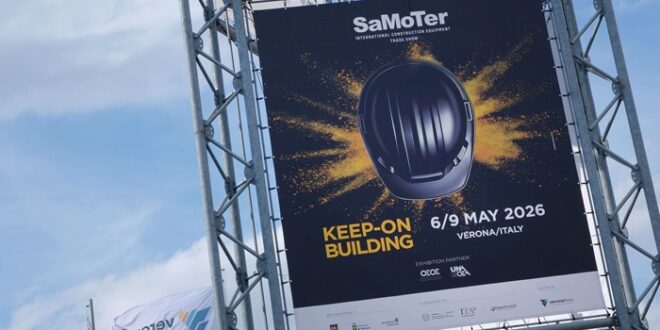
Data and outlook for the sector were presented by CER (Centro Europa Ricerche) on behalf of Unacea during the 32nd edition of SaMoTer, the triennial International Construction Machinery Exhibition, taking place at Veronafiere until Saturday, 9 May. In 2026, the number of machines sold in Italy is expected to reach an estimated 25,500 units.
Verona, 8 May 2026 – It is one of the most dynamic sectors of the Italian economy, characterized by high productivity, a strong export orientation, significant technological intensity, and an increasingly central role in the development of modern infrastructure and construction sites. This is the snapshot of the construction machinery sector emerging from the new study conducted by CER (Centro Europa Ricerche) on behalf of Unacea (the Italian Construction Machinery Association), presented yesterday at Veronafiere during the opening day of the 32nd edition of SaMoTer, the triennial International Construction Machinery Exhibition, running until Saturday, 9 May (www.samoter.it).
The study was presented at the conference titled “Construction machinery and Italian production supply chains: the overall economic dimension” by Stefano Fantacone, Research Director at CER. He emphasized that the sector represents a highly specialized industrial segment, closely linked to the transformation of production processes in construction and to the modernization of the infrastructure system.
In 2025, the Italian construction machinery market reached 26,000 units sold—almost double the 13,500 units recorded in 2017—confirming sustained long-term structural growth. After peaking in 2022 (29,700 units), the sector is now entering a phase of normalization. A slight contraction to 25,500 units (-1.9%) is forecast for 2026, against a macroeconomic backdrop of moderate GDP growth (+0.3%), a slowdown in construction investments (-0.3%), and inflationary pressures linked to energy costs exceeding 20%.
The total production value of the sector is estimated at €4 billion, with 6,000 direct employees rising to 85,000 when the entire supply chain is considered. These figures highlight not only the sector’s economic scale but also its capacity to generate skilled and geographically widespread employment.
Its competitive positioning is further strengthened by a marked international orientation. In 2025, the sector recorded €3.2 billion in exports compared to €2.3 billion in imports, resulting in a positive trade balance of €900 million. Nearly two-thirds of domestic production is destined for foreign markets, confirming the technological strength and global competitiveness of Italian companies.
Within the European context, the research clearly highlights Italy’s strengthened role in the construction machinery market. In 2025, Italy ranked as the third-largest European market by units sold, after Germany and the United Kingdom, overtaking France and securing a European market share of approximately 15%, up significantly from 9.6% in 2019.
This reflects growth dynamics running counter to other major countries. Between 2019 and 2025, the Italian market expanded by +38.8%, compared to an average European contraction of -9.4%, with significant declines in France (-28.3%), Germany (-22.7%), and the UK (-5.8%). Italy is thus the only major European market to have surpassed pre-Covid levels, reinforcing its competitive position and assuming an increasingly central role within the continental sector.
The sector is also distinguished by its strong integration with the construction supply chain, directly supporting worksites, infrastructure, civil engineering projects, and specialized activities. The three connected production branches—civil engineering; demolition and site preparation; and installation of electrical, plumbing and other construction systems—generate a combined production value of €135 billion and employ approximately 694,000 workers.
Between 2019 and 2023 (latest available Istat data), the production value of these three branches increased by 69%, compared to overall Italian production growth of 32%. The fastest-growing activity was demolition and site preparation (+73%), followed by installation activities (+70%). Civil engineering grew by 65%.
Another distinguishing feature of the sector is its high level of technological innovation. More than 35% of companies make medium-to-high investments in research and development, while between 35% and 44% invest in technology and digitalization to support the ongoing mechanization and transformation of worksites. Construction machinery thus acts as an enabling factor for productivity, workplace safety, and reduced project timelines, contributing significantly to the modernization of the entire supply chain.
Several representatives of leading brands exhibiting at SaMoTer 2026 also spoke during the presentation.
Gianluca Calì, Marketing Director of CGT Spa: “The performance of our market is directly proportional to that of the construction sector. The National Recovery and Resilience Plan (PNRR) has certainly boosted infrastructure projects and, consequently, the market has shown positive trends recently. However, contingent factors continue to influence customers’ purchasing decisions, as do various incentive schemes. Looking ahead, the sector has significant room for improvement in productivity recovery: all operators must invest so that customers understand that new technology translates into greater efficiency and productivity.”
Luca Evangelista, Sales Director of Volvo CE: “The Italian market is showing positive signs compared to other European markets. The encouraging results we see today are the outcome of work started several years ago. Slight declines should not be interpreted as negative signals or crises but rather as a phase of adjustment linked to broader economic trends. In the earthmoving segment, we are placing many machines on the market, while Germany, France and the UK have seen significant declines. This shows that Italy is delivering strong numbers thanks to groundwork done previously. Incentives have certainly played a role, but machines are purchased only when there are real projects. The PNRR has provided strong momentum, encouraging investments in connectivity, digitalization and sustainability—areas where returns are consistently positive. The real challenge now is maintaining this level”.
Maurizio Tosi, Territory Manager Plants Italy at Ammann Group: “Despite the economic crisis linked to rising fuel prices, energy costs and raw materials, companies still show strong willingness to improve, invest and grow. The Italian market continues to deliver positive results, while Europe is experiencing significant declines. Incentives such as Industry 4.0 and 5.0 measures have been driving forces, but much also depends on companies’ capacity to continue investing. However, regulatory issues—particularly in the road machinery segment—remain problematic. Installing an asphalt plant requires numerous authorizations from different authorities that often fail to coordinate. This creates serious difficulties: approvals may take six months—or more than three years—depending on interpretation. Such uncertainty inevitably discourages investment”.
Filippo Venieri, Sales and Marketing Manager at VF Venieri: “Forecasts for 2026–2027 are difficult to interpret, although I see strong willingness to invest among companies in the sector, which gives hope for the future. One message I would like to convey from SaMoTer is the need to invest in young people to attract top talent and train the operators of tomorrow”.
Marco Ferroni, Business Director at Kobelco Construction Machinery Europe: “Since 2026 did not start particularly well, it may prove challenging for the sector. However, if corrective measures are taken quickly, 2027 could move against the trend seen in other European countries”.
David Bazzi, CEO of Komatsu Italia: “The incentives granted in Italy have certainly provided significant advantages to construction machinery manufacturers. However, in the current context of geopolitical crises, rising component costs and, above all, logistical challenges are creating serious difficulties for the entire sector.”
Source: Samoter Press